
What Is Permanent Roofline, Eave and Soffit Lighting?
Permanent roofline lighting in Portland is a fixed run of individually controlled lights housed in aluminum track. Track color is matched to the surface it mounts against, so the run reads as part of the home during the day. Where it goes matters as much as what it does.
Eaves, soffits and rooflines each present different angles, materials and sight lines. Getting those details right is what separates a clean installation from an obvious one.
Who Is This Service For?
This service suits homeowners who care as much about the daytime finish as the nighttime effect.
- Owners of newly built or recently renovated homes
- Homeowners with complex rooflines and dormers
- Anyone who has seen a poorly installed system nearby
- Detail-focused homeowners planning a long-term upgrade
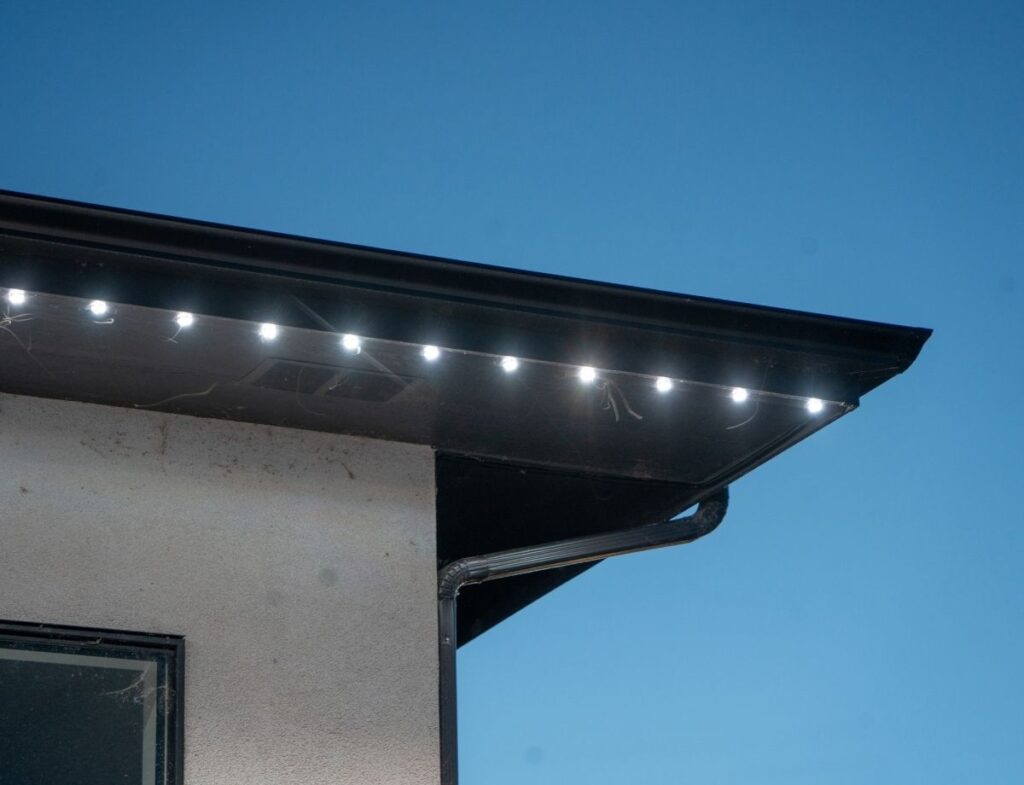
Where the Track Actually Goes on Your Home
Placement is decided before installation day, during a walk of the home and a review of your design mockup. Each run is mapped to the lines your eye already follows, rather than forced into a straight line the home does not have.
Different homes call for different answers. A single-story ranch, a two-story home and a house with deep overhangs each get their own plan.
The Placement Points We Plan Around
These are the surfaces and features that shape almost every layout.
Roofline and peaks
The main run traces the roofline so the outline of the home reads clearly at night.
Fascia boards
Mounting to fascia keeps the track tight against a flat, consistent surface.
Soffits
Recessed soffit placement tucks the track under the overhang and directs light downward.
Corners and returns
Corners are cut and finished so the run turns cleanly instead of bending awkwardly.
Gutters
Existing gutters are worked around so the track sits neatly alongside them.
Transitions between roof levels
Steps between levels are planned so the run stays continuous and visually even.
Architectural features
Gables, dormers, columns and entry details can be picked out where it suits the home.
What a Clean Installation Looks Like Up Close
Standing at the base of the home is where installation quality shows itself.
Straight runs
Track is set to a consistent line so the run does not wander along the fascia.
Proper spacing
Even spacing between lights avoids the gaps and clusters that make a system look homemade.
Color-matched aluminum track
The channel is finished in a shade taken from the surface it mounts against, not one that stands out from it.
A low-profile edge
The channel sits close to the surface, so it reads as trim detail from the street.
Tidy transitions
Direction changes and end points are finished, not left as visible loose ends.
How Thoughtful Roofline and Soffit Placement Changes the Result
Two homes can carry the same product and look nothing alike. The difference is almost always in where the track sits and how carefully the runs were set.
Good placement may also make the system easier to live with. Light lands where you want it, and the hardware stops competing for attention in daylight.
What You Notice Once the Runs Are In
These are the differences careful placement tends to produce.
A finished daytime appearance
Color-matched track along the fascia reads as trim rather than added equipment.
A crisp outline after dark
Continuous runs give the roofline a clean, defined edge instead of a broken line.
Even light across the front
Consistent spacing may keep brightness steady from one end of a run to the other.
Features that stand out
Gables, dormers and entry details can be lit deliberately rather than by accident.
Light aimed where you want it
Soffit placement may push light downward toward walls and walkways.
Roofline, Eave and Soffit Installation at Permanent Lighting PDX
Planning starts with your home, not a template. The roofline, fascia, soffits, corners, gutters and transitions are all reviewed before a single length of track is cut. Your free design mockup then shows how the finished result will look.
Bosso Permanent Lighting is the product behind every installation, carried in color-matched aluminum track and built for year-round Pacific Northwest weather. A 5-year manufacturer warranty applies, extended protection is available, and local support stays on hand for service and additions.
Frequently Asked Questions
Where is permanent lighting track installed on a house?
Track is normally installed along the roofline, fascia or soffits, depending on how your home is built. Corners, gutters and transitions between roof levels are all reviewed during planning so the run stays continuous. Your design mockup shows the intended path before installation day.
Is the aluminum track noticeable up close, and how does it attach?
Up close the channel sits low against the surface it mounts to, finished in a matching color. On most homes it fastens along the fascia, or tucks up under the soffit where the overhang is deep. Seeing it on your own home in a design mockup is the simplest way to judge.
Can the lights follow soffits and eaves as well as the roofline?
Yes, soffit and eave placement is common and often the better choice on homes with deep overhangs. Tucking the track under the overhang keeps it out of direct sight lines and directs light downward. The right approach depends on your home’s construction and how you want light to fall.
What happens on a home with dormers, angles or several roof levels?
Complex rooflines are planned in more detail rather than simplified. Each level, angle and transition is mapped so the runs stay even and the outline of the home still reads clearly. Features like gables and dormers can be included or left out, depending on the look you want.
Can I light just the front of the home instead of the full roofline?
Yes, the layout is planned around the sections you want lit rather than a fixed formula. Many homeowners start with the front elevation and the main approach, then add runs later. Local support is available for additions once you have lived with the system for a while.
See the Plan for Your Own Roofline
Placement is easier to judge on your own home than in photographs of somebody else’s. A free design mockup shows exactly where the track would run before you decide anything.